Zak Hynes just spent his holidays back in the UK, in a small town called Lincoln, which he describes as “very old school, with cobbled streets and a big hill.” New Year’s was a far cry from fireworks on a boat in Dubai. It was quieter, colder, a little quaint, but still good to be home with family.
That said, he was glad to be back in Dubai. It’s where he lives now, and where, over a conversation with Mark Chahwan, Sarwa’s CEO and co-founder, Zak sat down to unpack his investing journey, how it has evolved, and the decisions that shaped it.
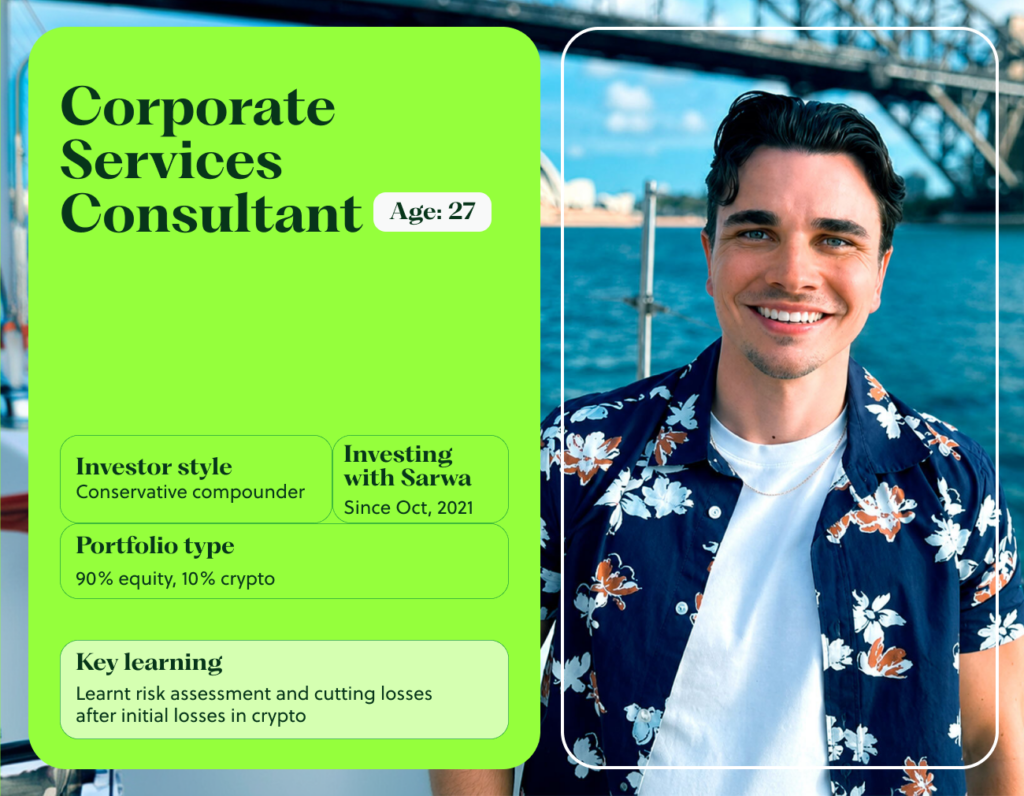
You’ve landed on a portfolio that’s roughly 90% S&P 500 and 10% split between Bitcoin and Ethereum. Can you walk me through how you got there?
Zak: The way I landed on it was from a risk allocation perspective. Obviously, being in my late twenties now, I can afford to have a higher risk percentage allocated in my portfolio. But extreme high risk, which is what I categorise cryptocurrency as, is only 10%. I prefer to have the remaining 90% allocated to the S&P. It was originally going to be a sort of 80/20 bond to asset split, but when I looked at the data, I thought I can afford to take more risk, but not so much that I’m uncomfortable with it. The S&P (VOO) fit that perfectly. It consists of the top 500 companies and I’m confident with the way those companies are operating. If one goes out, it’s not the end of the world. That 10% is more “play” money that I can certainly afford to lose. But, it’s never a set thing. I’m always interested in learning other ideas and perspectives.
The last few years have been volatile. Did that test your discipline?
Zak: I’m very good at tuning things out and not checking my investment platform every two minutes, which I think was a big benefit. I also believe in “time in the market versus timing the market.” But yeah, there was definitely a lot of downs, particularly in the crypto up-and-down spiral. I think it was 2021 when Bitcoin crashed, and NFTs were trending. It was a crazy time. That was probably more uncertain for me in terms of risk allocation. I got a bit burnt on the crypto side, and that was a valuable lesson in reducing risk and how much risk I want to take.
What specifically went wrong, and when did you course-correct?
Zak: I was over-leveraged. Not leveraged in the borrowing sense, but over half of my portfolio was allocated to cryptocurrencies. During the highs, you’re thinking, “I could do no wrong, I’m invincible.” And you invest in things that you wouldn’t normally be investing in. Then during the lows, I was still holding on to that way of thinking. It must have been 60% of my overall portfolio. That reduced from 60% to about 5 to 10%.
I look back at it now thinking I’m glad it happened, because had that continued, I wouldn’t be where I am today. The biggest lesson is taking a step back, thinking about things and doing your research. Yahoo Finance has been inon my bookmarks ever since 2021. How long has this been going, what’s within this fund, how does it operate, what are the fees, especially if you’re looking to hold something long term. That’s the biggest lesson by far.
Did you reduce your exposure, or were you able to ride it out?
Zak: A bit of a mixed bag. But, think of the least sensible choice and that’s the choice I took.(laughs)
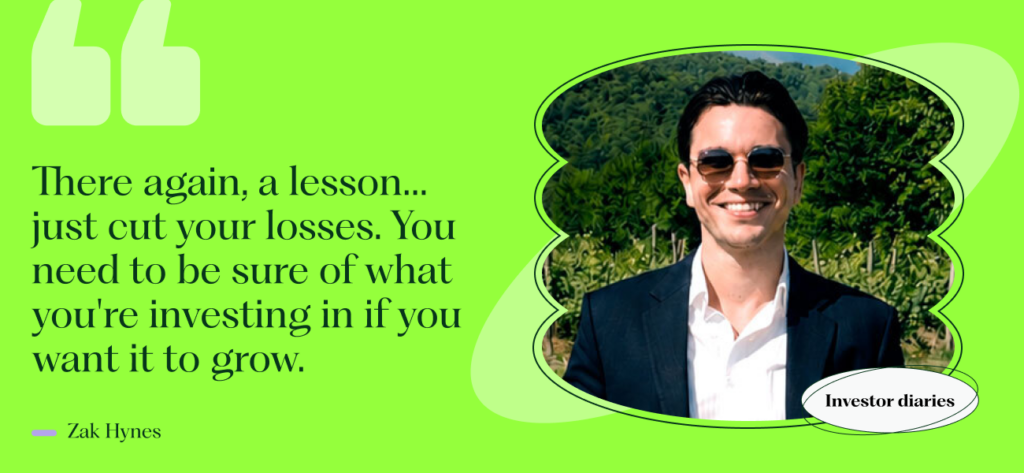
Because of the mindset that I had through the boom period, on the way down. In certain parts of my portfolio, trying to purchase more with the assertion that “yes, this will keep going up.” When in reality, it’s not likely. Around six months after it started declining, I told myself, “Let’s cut the losses.” But that was six months. More than it should have been.
You’ve moved across a bunch of companies, so I’m just curious to understand your career evolution.
Zak: I try to keep them separate in terms of my personal investment and my professional career. But, I’ve always followed the consultancy path. I started off as a real estate agent in the UK and then went into management consultancy. As a junior, my first project was in dog biscuit manufacturing, which I can tell you smells about as good as you’d think. (Mark laughs)
But that was sort of cutting my teeth. I thought, “Oh, this is quite interesting. You get a peek behind the curtain of companies, and you get to see people make a real difference.” That stuck with me. I was in the UK for about two and a half years to three years. Moved back to Dubai in 2020, where I grew up. So there is an interesting adjacent sector to consulting here, the company incorporation side of things. In the UAE, there are around 56 different jurisdictions, and all of them have niche requirements. The government here has built an interesting ecosystem. So I started off at a basic consultancy firm and then expanded from there. I’ve been in the consulting/corporate structuring sphere since then.
How did you look at the move from the UK back to Dubai?
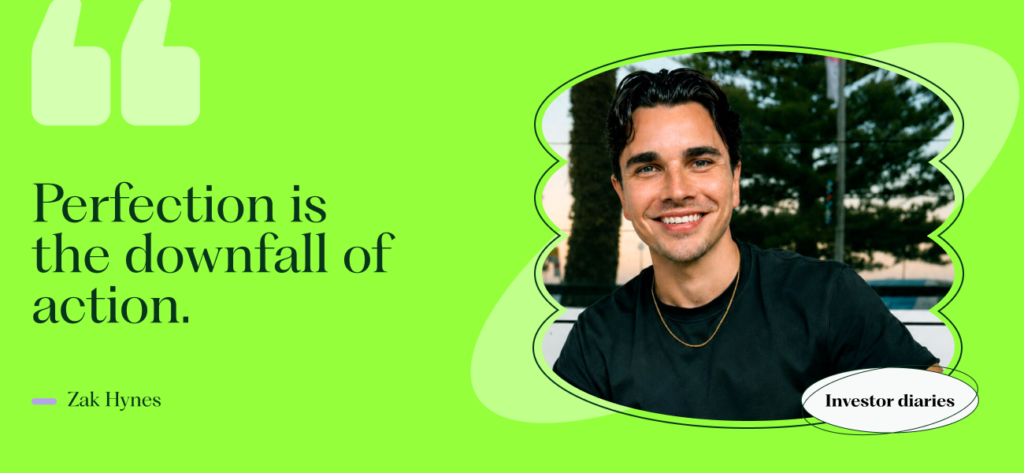
Zak: I think taking risks is the most important thing someone can do. The Dubai move is a good example. I went back to the UK on a Christmas holiday to see family. I enjoyed Manchester as a whole, but coming here and getting the nostalgia of what I grew up with, and then seeing how much the region had changed, I realised “Okay, Manchester doesn’t really compare to this.” So in a snap decision, I cancelled my return flight, had a conversation with my father and decided to give it a go here. My sister kindly moved all of my stuff out of my Manchester apartment, which meant I didn’t have to go back. There was no planning, but it worked out well. You can’t always wait for the perfect moment.
Mark: That’s really cool because Dubai is a novel place for many people, but to you it was also familiar.
Zak: Yeah, that’s the perfect way to put it.
What shaped how you think about money and investing?
Zak: My father played a big role in this. I sit down with him, have a coffee, take a step back, zoom out. That was my biggest guiding principle. I come from a family that’s never had a significant amount of wealth, so I know the value of money, and I know that making the right decisions matters more than making a volume of decisions.
Then obviously all of the books followed. I have one next to me right now, the classic Rich Dad Poor Dad. I think that’s how everyone starts. Basic financial literacy, accounting, and then we progress from there.
Last question. Based on your mistakes and investment journey, what’s your advice to someone just starting?
Zak: Filter out the noise. That’s the biggest thing someone can have when they’re first starting out, and it’s something I wish I had done. You have so many voices saying you should invest in this and that. Rarely, myself included, are you able to take a step back and say, “What are my goals? What are my objectives? Does this align with what I’m trying to do?” Nine times out of ten, if you have some level of financial literacy or the willingness to learn, it’s so much easier than listening to all of that noise.