
If you were not born into wealth, does that mean achieving financial independence is out of reach?
Not according to a national study of US millionaires conducted by Ramsey Solutions, a financial advisory firm. They concluded that “79% of millionaires did not receive any inheritance at all from their parents or other family members.”
This is not unique to the US. About 60% of Dubai millionaires are also self-made, according to the Khaleej Times.
What then is the secret of living a golden life? About 75% of those interviewed by Ramsey Solutions said regular and consistent investing over a long period led to their success.
Does this seem unrealistic? Then consider that if you invest AED 10,000 at the end of every month for the next 10 years in a portfolio that generates an 8% annual return (that compounds every quarter), will have AED1,824,086.73 at the end of year 10.
In this beginner guide to investing, we will help you understand how to invest money in the UAE so you can also build wealth for yourself and your loved ones. We’ll cover:
- Preparing to invest: Taking control of your finances
- Where to invest money in the UAE? UAE investment opportunities
- How to invest money in the UAE: 4 principles for beginners
- Creating an investment plan
[Do you want to know more about how to invest money in the UAE? Subscribe to our newsletter today to have weekly investing resources delivered to your inbox]
1. Preparing to invest: Taking control of your finances
“The building blocks of growing wealth are creating a gap between your income and expenses and then investing the surplus in something that produces income or appreciates in value over time,” according to Elie Irani, an IT professional and personal finance enthusiast, in a podcast episode with Sarwa.
Before considering the second part – investing the surplus – let’s spend some time helping you pull your finances together so you can create a gap between your income and expenses.
Have a budget
The best way to gain control of your finances is to have a budget. “A budget is telling your money where to go instead of wondering where it went,” according to John Maxwell.
One popular budgeting rule that we also recommend is the 50/30/20 rule. This requires that you spend 50% of your monthly income on your needs (rent or mortgage, clothing, utility bill, etc.) and 30% on your wants (entertainment, hobbies, eating out, etc.). The remaining 20% is your monthly savings.
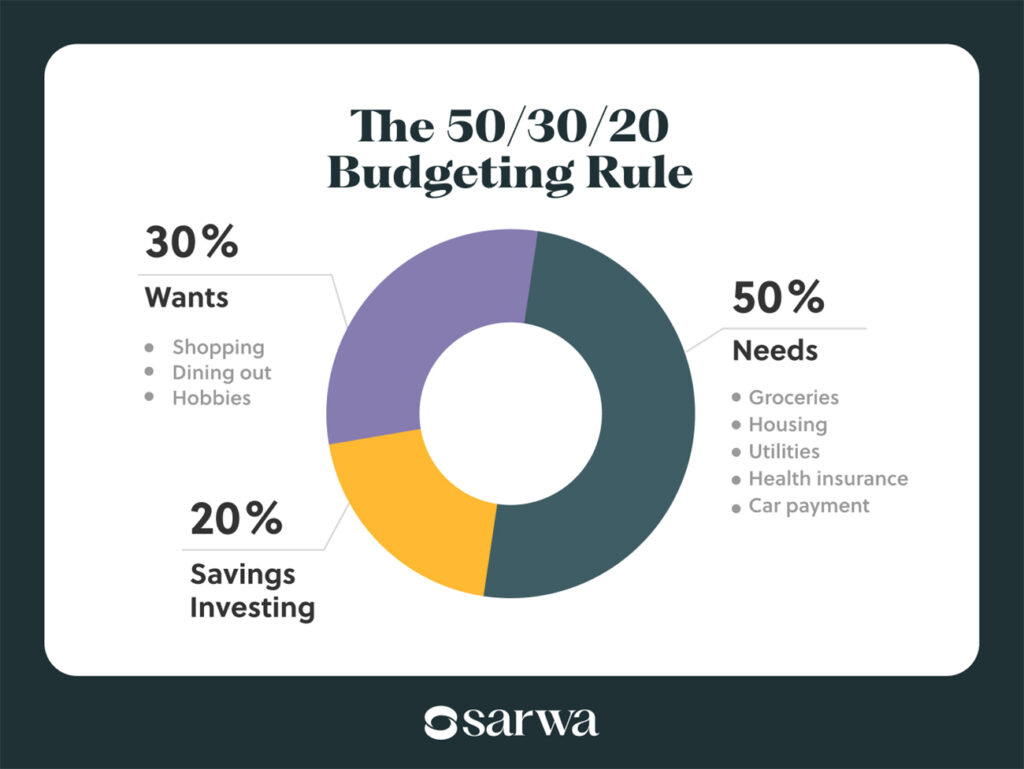
This 20% is so important since one of the aims of budgeting is to ensure that you are spending less than you earn.
Stick to your budget
It is not enough to have a budget, you need the discipline to stick to it. For our purposes, the best way to stick to your budget is to save before you spend. One of Warren Buffett’s quotes is that you should not “save what is left after spending, but spend what is left after saving.”
If you keep your savings in the same account you keep the money you spend on needs and wants, then the temptation is always there to overspend.
To counter this, it is best to first remove your savings and put it in your investment account while you develop the discipline to stick to the amount you have allocated for your needs and wants.
Create an emergency fund
Before considering the best investments in the UAE, you should learn how to start an emergency fund.
An emergency fund is money set aside to cater for unplanned and unexpected expenses resulting from job loss, medical crises, natural disasters, and unexpected repairs, etc.
If you start investing without an emergency fund, you may end up liquidating your investments when emergencies arise. Or you may have to rack up credit card debt (or any other form of consumer debt) and pay exorbitant interest on such.
An emergency fund is a better alternative. Financial advisors often advise that such an account should have up to six months’ worth of your living expenses (needs and wants).
For emergency funds, the primary factor is the ease of access (liquidity) rather than profitability. Put your emergency funds where you can access them when (and only when) emergencies arise.
2. Where to invest money in the UAE? UAE investment opportunities
If you implement the three strategies above, then you already have a consistent and regular source of investment capital: 20% of your income.
But how should you invest this money?
Financial scams are everywhere! Maybe you have been approached by money doublers who promised to double your money in days or those who said they would make you millionaires in weeks.
Instead of being captivated by such get-rich-quick schemes, you should focus on investment assets that people have successfully used to build wealth over centuries.
A second point is in order. While starting your business is an option to build wealth, the entrepreneurial journey is uncertain (90% of them fail, according to Investopedia, the financial education website) and often requires a large capital outlay (that beginners don’t have) to achieve decent success.
Therefore, as Irani advised in the podcast quoted above, we will focus on the financial markets since they have “low entry points” (no entrepreneurship skills needed) which makes them available to the average Joe.
So, then, what are these safe investment options in Dubai for Emiratis and expats?
1. Stocks
A stock is a portion of a company’s capital that individual and institutional investors can own.
When you purchase a company’s stock, you own a portion of the company. There are two ways to make money from stock ownership:
- Dividends: Most companies decide to share a portion of their net income with shareholders. This portion is called a dividend. The company pays a dividend based on the number of shares you hold. Most companies pay dividends every three months.
- Appreciation in the stock price: For our purposes (long-term investing), the appeal of stocks is how their prices can rise over the years. For example, 10 years ago (August 1, 2014), a share of Google (GOOG) sold for $28.23. On August 1, 2024, the closing price was $172.45. That is a 511% increase.
If you had invested $1,000 in GOOGL 10 years ago, that money would be worth $6,109 by now.
How to invest in the stock market
To invest in the UAE stock market, you will need a stockbroker, who will provide you access to any of the three stock exchanges in the UAE — Dubai Financial Market (DFM), NASDAQ Dubai, and Abu Dhabi Securities Exchange (ADX).
A stockbroker is an intermediary that facilitates transactions between buyers and sellers on stock exchanges. As an individual, you cannot buy or sell stocks in the UAE stock market (or any others) without a broker. Therefore, learning how to invest money in the UAE stock market begins with choosing the right broker.
Any broker operating in the UAE will give you access to any of the three UAE stock exchanges above.
However, if your financial goals require you to buy foreign US stocks like Apple, Google, Facebook, etc., you will need a broker that can grant you access to international stock exchanges like the New York Stock Exchange (NYSE) and NASDAQ.
But why should you learn how to buy US stocks in the UAE?
It is no secret that the largest and most successful companies are in the US. This should not be surprising since the US remains the wealthiest country in the world.
Consequently, the US stock market remains the greatest source of wealth for stock investors. Furthermore, it is the largest in terms of capitalisation, transaction volume, and the number of listed companies.
Since our aim is to build wealth, focusing on the US stock market is a no brainer.
2. Bonds
A bond is a debt instrument that governments and corporate companies use to raise money. For our purpose, there are three types of bonds:
- Corporate bonds: Company issuances
- National bonds (Treasury bonds): Federal government issuances
- Municipal bonds: Local government, state, city, and local community issuances
You can make money from bonds in two ways:
- Interest payment: Bond issuers make interest payments to bondholders twice a year. Unlike stocks, bonds have a fixed interest rate.
- Growth in the bond value: You can also make money when a bond grows in value. When the interest rate drops and new bonds are issued at lower interest rates, your bond’s value (which was issued at a higher interest rate) rises. When the stock market is down, many people turn to bonds, sending their prices up.
Bonds are generally issued for a long period.
Unlike stocks that you can own forever (provided the company does not repurchase them), you can only hold bonds for a predefined period.
Bonds provide a consistent stream of income for a certain amount of years, such as 10-year and 20-year bonds. You can also earn on them by selling them at a higher price before maturity.
Bonds are considered less risky compared to other investments and are typically used as a counterbalance to stock investments.
“Every portfolio benefits from bonds; they provide a cushion when the stock market hits a rough patch,” says Suze Orman, founder of Suze Orman Financial Group. “Every portfolio benefits from bonds; they provide a cushion when the stock market hits a rough patch.”
However, their return is not as high as stocks: less risk equals smaller returns.
When it comes to investing in corporate bonds, investors should conduct diligent research to understand if the company has a low-risk profile, as defined by bond rating agencies.
3. Mutual funds
For those without the time or skills to evaluate the stock market (and that is most of us), stocks and bonds are also available for purchase through mutual funds.
A mutual fund (also known as investment fund) pools money from various individual investors and invests them in stocks, bonds, and other fixed-income securities under a fund manager’s supervision.
The fund manager is an expert who understands the market and has the experience and skills to choose individual stocks or bonds.
By pooling a large sum of money from different individuals, mutual funds offer diversification as they can invest in more companies.
When someone purchases a mutual fund, they own a portion of the mutual fund rather than the individual investments (the mutual fund operates as a company). In other words, the shareowner doesn’t own the stocks or bonds the mutual fund purchases; instead, they own the mutual fund itself.
Within a mutual fund, there are equity funds, fixed-income (debt) funds, balanced (hybrid funds), and specialty funds.
How do mutual funds make money?
- Dividend/interest: When the stocks or bonds the mutual funds purchase pay dividends or interest, they distribute it to the mutual funds’ shareowners depending on the number of shares.
- Appreciation in the mutual fund’s value: The price of a mutual fund increases as the value of the stocks and bonds it possesses increases. Also, the price of a mutual fund rises as the demand for it increases.
As the mutual fund grows, the value of the share price grows.
There are different types of mutual funds based on how they trade and the investments they purchase.
Based on trade, there are:
- Open-ended mutual funds: These are mutual funds you can buy or sell throughout the year. You can add more units or sell the ones you have.
- Close-ended mutual funds: You can only sell close-ended mutual funds at a specific maturity date. You hold it until maturity.
Based on the philosophy of investing, there are:
- Passively-managed funds: Passively-managed mutual funds (also known as index funds) attempt to match the performance of t