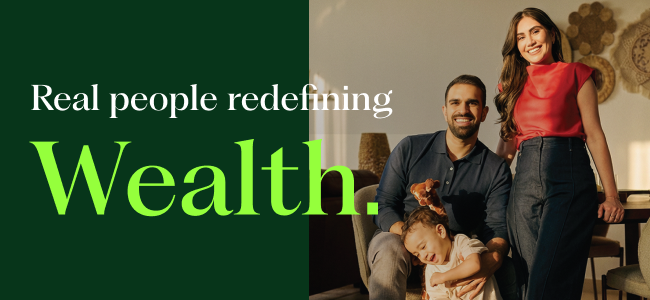
For Saadique, financial freedom isn’t, as opposed to what we so often hear, about retiring early. For him, freedom means sleeping well, and planning growth in investments, in his career, and in his skills. It means an assurance that income will grow and investments along with it.
To start us off, how did you discover Sarwa?
Saadique:
To start off with some context, I was exposed to investment pretty early where my parents had a strong investment culture at home and saw how they saved and invested for our education and future. So it was obvious to me that the moment I earned my first dollar, a portion of it had to be invested. It was my first lesson on how one can generate wealth through compounding over a period of time.
From every internship during my university years to my graduate job at a BIG 4 accounting firm, every dollar I earned, had to be invested. At the time, it was only Indian markets in mutual funds and blue-chip stocks, and then as I understood risk and fundamental analysis as qualified chartered accountant, I diversified into US stocks. I was always interested in how like companies prepare their balance sheet and build their net worth, can individuals build their own balance sheet and explore ways to build their wealth and increase their net worth. In 2021, I was moonlighting with a startup at DIFC, that focused on helping people with spare change investing. It was during that time of researching the most efficient ways of passive investing is when I came across Sarwa, exactly 100 metres away from where I was working. .
When I came across Sarwa, the ETF concept immediately made sense. It aligned with how I viewed mutual funds. Before fully committing in early 2022 I met with Amen Ghebre, the VP of Advisory & Investments at Sarwa, and spoke to Akshay Iyer, who was one of the Wealth Advisors. I wanted to understand the philosophy behind the company. In India, when you deal with mutual funds or policy funds, you always want to know who’s behind it and why they’re selling it. Trust matters.
After speaking with them, understanding how the operating model worked, where the money goes, and how everything is structured, I felt confident. Since then, it’s been a very good experience and I make sure to attend the Sarwa events
How important was it to get to know the people behind the company before investing?
Saadique:
Very important.
While working on the spare investing startup, I was interviewing potential investors and prospective customers. The biggest barrier was trust. You’d hear stories where one would lose their entire life savings either because they took too much risk on a volatile stock (including crypto), or the company turned out to be a fraud. One bad experience was enough for them to walk away from investing completely.
So when evaluating platforms like Sarwa and others, I looked at transparency first. What are they charging? Is it clear? How is my money being invested? Do I have easy access to it? Do I understand where it is invested? In these aspects, Sarwa was straightforward and simple to understand.
Then I met the team. I wanted to know if they were investing their own money on the platform. They were. That matters. Skin in the game builds trust.
I tested them with scenarios. If I want financial independence by 40, what do I do? If my dad is retiring, how can Sarwa help? They gave practical answers with numbers and historical context.
Trust and transparency are everything in money. After that, I introduced several friends and family into investing. I would tell them, start with $100 per month. Worst case, you lose $300 over three months. That’s manageable. Investing should be gradual. Even if you have a lot of money, you shouldn’t deploy it all at once, spread it out across months to spread the risk. That’s always been my philosophy.
Your investing mindset started early. What did you learn from your father?
Saadique:
We are four siblings and grew up in Saudi Arabia. For many NRI families, the path is clear: study in the Middle East, then move to India or the West for higher education.
My parents decided early on that in order to attain quality education, once must save for that early on and through investing. So they started investing for our education 5 years in advance. .
I remember in the eighth grade they told us how much they were investing every year for our education. My parents have always been transparent with us with money, so we value every dollar earned, saved and invested.
When I went to university in the UK, my education cost around £8,000 per year. To run some hypothesis, they may have invested only £4,000 or £5,000 of that amount over time. The rest came from compounded returns. That compounding created the difference between average and excellent education.
They also invested for weddings and future milestones years in advance. It was a very methodical and simple approach. The biggest lesson was compounding and planning early.
[Read our other features of Wealth’s New Look: “Marc & Maria” and “Amina & Horia“]
How has your relationship with money evolved over time?
Saadique:
By nature and by profession, I take calculated risks. It’s important to understand the correlation of risk and reward. Lower risk means lower reward, so sometimes I would push myself to take slightly more risk.
But what really changed is clarity. If I invest 10% of my income consistently in a well diversified fund/ETF, I know what it could be in five, ten, or twenty years. That visibility lets me make decisions confidently.
If I know I’m saving and investing 30%, then I don’t feel pressured to spend 70% of my income. With this mindset, you spend only on what you truly value and avoid unnecessary spending.
For example, daily coffees or business class travel isn’t important to me. Visiting family multiple times a year and going on vacation is important. So I adjust my spending accordingly.
Even with buzz around Dubai on the real estate investment, I ran the numbers. In 2017, I don’t think couldn’t afford a AED 1 million property. But I knew that by increasing my investment rate slightly and staying consistent, by 2022 I could afford more. That certainty helps you sleep at night and make good decisions backed with numbers.
How do you manage lifestyle expansion in a consumer-driven city like Dubai?
Saadique:
For me, 25% investing is non-negotiable. That’s the base.
Fixed expenses then take a portion. Variable expenses take another portion. Whatever remains can either be invested or saved for short-term luxuries. For my wife, who is a freelancer with cyclical income, she would apply the same 20-30% investment, irrespective of her earnings that month. This helps us create a buffer for any extra-spending on the experiences that our beautiful city has to offer.
Do you feel less guilty about spending because you invest consistently?
Saadique:
Yes.
I used to feel guilty spending on things like sports training. Now, if I spend 200 dirhams on a tennis session, I don’t feel bad because I know 25–30% is invested every month.
When you know your future is covered, you enjoy the present better.
How important is financial alignment as a couple?
Saadique:
It’s the most important, in my opinion.
Money could be one of the sources of conflicts if couples don’t talk openly about it. What matters is conversation.
In our case, if I take responsibility for core household expenses. My wife’s income is treated as growth for investments, experiences and her career. Other couples split 50/50. Both approaches can lead to the same financial outcome.
We have quarterly check-ins. We review investments, returns, upcoming expenses. It’s not complicated, but it keeps both of us aware. Without that, resentment builds. One person might feel the other is too stingy or too careless. Joint decision-making builds confidence and avoids misunderstandings.
How did you and your wife meet?
Saadique:
We met in college in Pune when we were 18. She was a year junior. I later moved to the UK for four years for my studies while she remained in Pune. We continued dating long distance.
After that, I moved to Saudi, and after eight years of long distance, we got married in 2016 and moved to Dubai.
What are your strengths as a couple when it comes to money?
Saadique:
We’ve seen each other grow from pocket money to full income. That history helps.
She’s slightly more of a risk taker as an entrepreneur, which I admire. I’m more calculated. Together, we land somewhere in between. That balance works well.
How do you think about teaching financial habits to your son?
Saadique:
He’s two and a half, so it’s early.
But I want to teach him compounding. Not just in money, but in habits, discipline, and effort. Small actions over time create big impact.
I also want to be transparent about money the way my parents were with us. Showing what we invest, what the returns are, and how we plan.
What does financial freedom mean to you?
Saadique:
It doesn’t mean retiring early.
It means sleeping peacefully and planning growth. Growth not only in investments, but also in career, skills, and experiences.
If you earn 10,000 per month for 30 years, even if you invest 20%, that’s fine. But if you invest in your skills and grow that income to 30,000, 20% of 30,000 is very different. Financial freedom is having that flexibility to grow across all areas.
Final thoughts
You might be wondering why we’ve chosen to focus on everyday people instead of the Warren Buffetts or Peter Lynches of the world. Well, we did it because Sarwa exists for people who are figuring out money in real life. We wanted to highlight how people actually think about money under the pressures they face.
At that point it became clearer to us that we needed to do away with all the smoke and mirrors that usually make up ad campaigns. The only way to do that was by speaking to real people, and letting them speak for themselves.
Please note the views expressed above reflect the personal experiences of the individuals featured and are shared for illustrative purposes only. They do not constitute investment advice or a recommendation to invest.