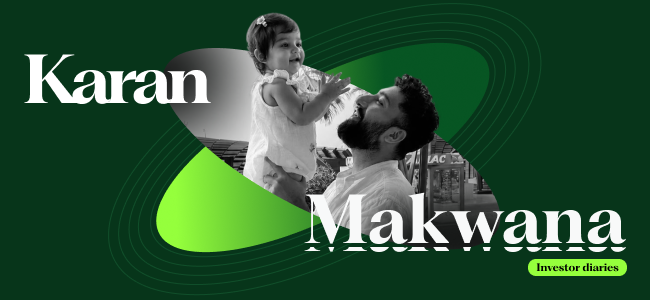
Karan Makwana had just come back from India. It was the first time he took his one y.o daughter to meet the entire family. A celebration of around 180 people within the first week, then 12 to 15 family members coming to the house almost every day. He was expecting the scale of it to overwhelm her, but she was fine. More than fine. She was relishing it. He and his wife were the ones who ran out of energy.
Mark Chahwan, Sarwa’s CEO and co-founder, sat down with Karan to unpack his investing journey. What unfolded was as much a conversation about investing as it was about being a father and husband. Along the way, Karan also touched on something rarely discussed in investing circles: the importance of having a spouse who trusts you enough to let you experiment, stay the course, and not pull the plug when the numbers go red.
How did you get into investing, and how did you land on the style you have today?
Karan: It was COVID, and I was at home. I told myself, “It’s about time I should invest.” I started investing with Sarwa. I have roots with the Indian stock market, with some of my family members being a part of it. But I just don’t understand the Indian stock market as much as I understand the US stock market now. So for me, the US felt like a safe option.
It took a couple of days to get the funds in. The challenge was, then, as a beginner, how do you move funds? How do you open an account? That was challenging to figure out.
I started with a small amount, put it in Sarwa. I was contemplating whether I should have the simpler investments where Sarwa helps me (Sarwa Invest), or if I should go and do things by myself (Sarwa Trade). I used Sarwa Invest and started putting more money into it. Over the months, it grew well. And then I started to study more, and I took it as a challenge to trade by myself.
Around that time there was a massive hype about Nvidia. Everybody was talking about Nvidia. As a child I grew up with computers which had Nvidia graphic cards. Everybody said Nvidia. I bought Nvidia, and Nvidia grew, and you could see its returns. I was happy with the returns. But I was not satisfied because it wasn’t my find. It wasn’t something that I knew. So then came the entire journey where I wanted to learn about what I’m investing into.
When you discover a company, what are you actually trying to understand about it?
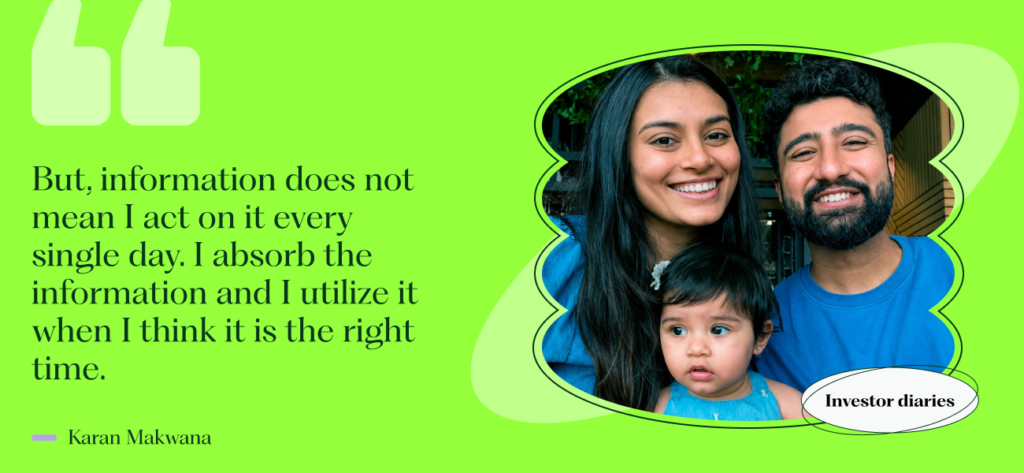
Karan: There’s no golden rule. You can’t have a strategy when you don’t know what’s going to happen in the future. What you can probably do is build a pattern within your brain by spending time. You will watch YouTube videos of investors, and you will read articles. The first article that you read should not be the article that makes you invest. You need to read more, absorb the information, and only take action when you feel the time is right.
But one very important thing: when a lot of people have conversations with me, they ask me where I get my information from. What I think the right question to ask is, what do you want to really know? Because information is out there in abundance.
Emotions are cited as one of the biggest enemies of investing. What did learning that lesson actually look like for you?
Karan: My issues were not with buying. My issues were with selling.
The market did swing, and I did react. And after I reacted, I had this gut feeling. So the gut feeling I chose to follow was one of the gut feelings. If it worked, it was a good gut feeling. If it did not work, it was a bad gut feeling. That’s when I realized I should not be acting on gut feeling. I should be thinking.
So I started to diversify a lot more. I started to look at different industries, mid caps, larger stocks. Then I met more people and people gave me different opinions.
- Never buy the news, never buy the hype.
- Don’t try to time the market. You’re not going to win against the market. Try to be in between.
- Don’t try to aim for the lowest and don’t try to sell at the highest.
- If you’re okay with marginal profits and if you’re consistent throughout the year, those marginal profits when they accumulate become bigger profits.
The biggest learning I’ve had is not to always make the right decisions, but to make fewer emotional reactions. Separate logic from emotions. And that’s where you will automatically realise that you can’t love one particular stock or one particular company or one particular ETF. You need to unmarry yourself from those tendencies. It’s like mental math, but I call it “math -> mental”. When you know the math, you’re mentally calm.
How are you entering 2026?
Karan: I always keep some spare cash. The reason I keep spare cash is because I don’t believe I have the right formula. The spare cash for me is either a good fund when the market goes down. And if the market is going up, I’m happy anyway. If I’m completely invested and things go down, then I will regret not having spare cash.
This year is pretty fantastic because there are so many things happening. There is uncertainty throughout. But with uncertainty comes opportunity. I am not going to pull a lot. I’m going to keep that spare cash. And whenever I feel it is a good time to invest, I will inject that money into companies that I feel have large growth potential.
Where do you stand on Bitcoin and crypto more broadly?
Karan: Gold price is increasing, and I see gold as a store of value. Bitcoin is another store of value. I think the younger generation does not believe in buying gold but would probably be buying Bitcoin. Every single time I meet friends and relatives and they have to give me a gift, I say please give me a bitcoin. Give me a portion of bitcoin. If it goes down, it goes down. But I do feel bitcoin has a strong path ahead.
I come from India, so tradition in India is during your wedding, they give you gold. That’s the only gold I would probably buy. Physical gold. Just a few months ago I messaged my wife and told her, if you want to invest in silver. She was like, “why silver? Silver oxidizes.” I said, no, it’s not just about oxidization. It’s about the utilization of silver. Silver has a lot of potential in a lot of industries and the demand is increasing. I think silver outperformed gold in the last few months because of its utilization in industries.
Now I don’t think it’s just about store of value. But also in the future, if Bitcoin is just a store of value, how is it then going to be utilized? Because at the end of the day, Bitcoin is still very slow, it’s heavy on energy consumption, and I do believe there might come alternatives. It really depends on whether it solves a problem that Bitcoin possesses. If it can bridge that gap, then that particular asset has better potential growth.
The other crypto options are a bit more risky, but if I were to take that risk, I’d start with a small amount
You became a father recently. Has that changed how you think about money and investing?
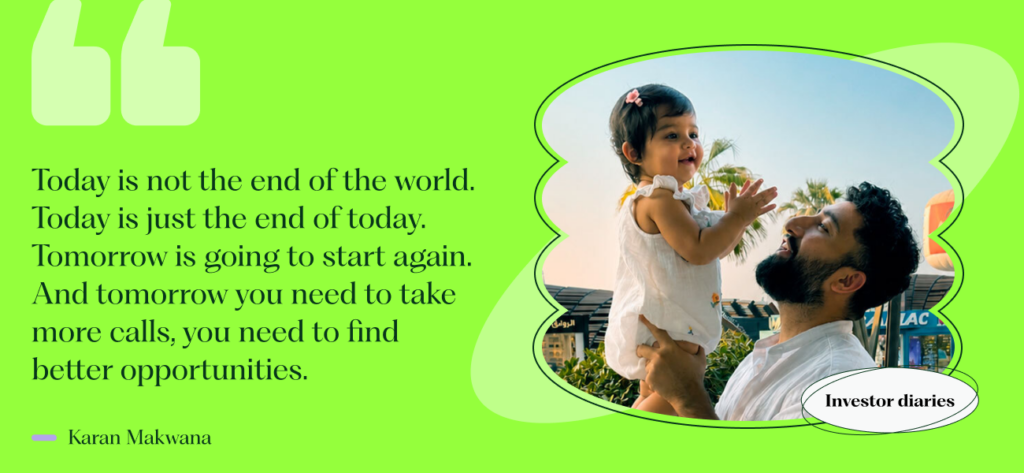
Karan: I’m glad you asked this question. When I was single, I was ready to take big risks. The moment I became a family person, I had my wife, we started to build dreams, we had certain goals. When I became a father, I got even more careful with my investments. And being careful does not mean you’re always going to have success. Market swings. Success goes up, success goes down.
But in that time, we had complete transparency. I always told her every single night. I’d show her my portfolio. “Look, we went up. Look, we went down.” She never flustered. She’s always been supportive. She always keeps telling me, okay, very good, what’s next? What is the next thing you’re going to do now?
My mindset changed for sure. I became a little bit more grounded. But my wife made sure I was never slowing down. She doesn’t want to know the analysis. She doesn’t want to know anything about the stocks. If the day was bad, no problem. I trust you. You’re going to do this tomorrow. It’s just numbers. Numbers go down, numbers go up. That support and alignment was very important.
And I think everybody should trust themselves as much as they want to be trusted by others. If the big hedge funds are not stopping, why should you? Family pressure can make you pull the plug. A lot of people do it and then they regret it. So if you’re a spouse knowing your partner is doing this, be encouraging. Very important.