When the first internship paycheck landed during university, Carl turned to his mentor, his uncle, who had been investing for 20 years. That conversation changed everything. Now four years into his investing journey, Carl sits down with Sarwa’s CEO and co-founder, Mark Chahwan, to break down how he thinks about risk and why he’d rather own a few companies he truly understands than diversify for the sake of it.
How did you get into investing, and how did you land on a tech-heavy approach?
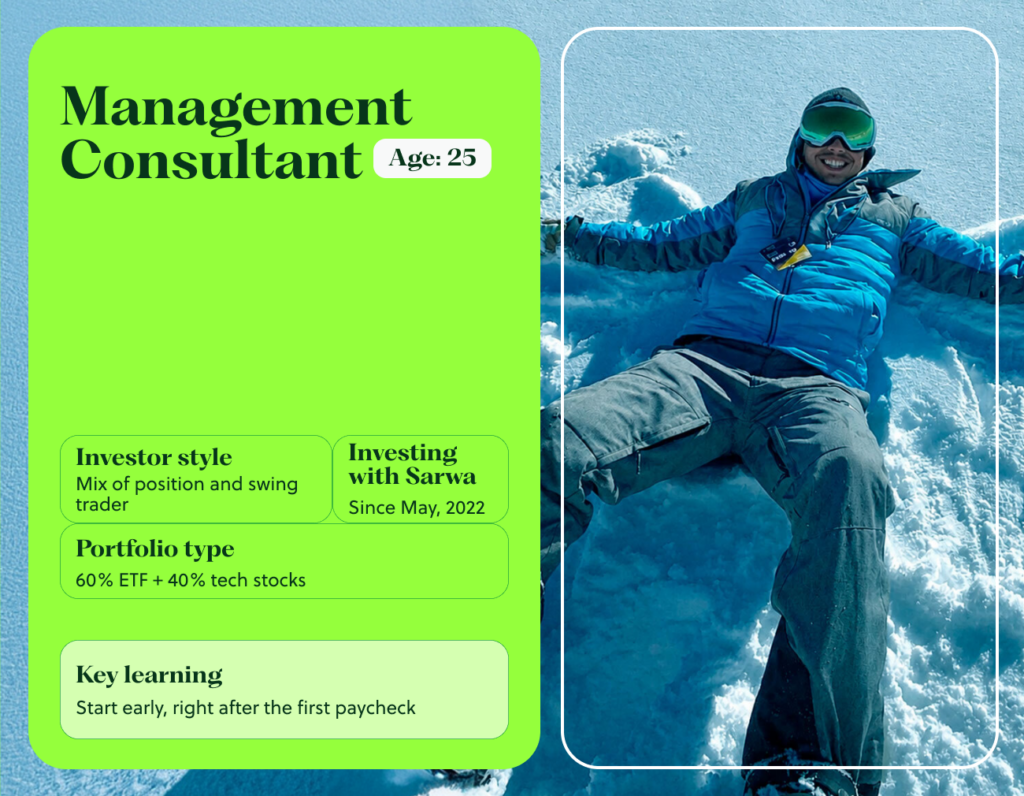
Carl: I started getting into the field back when I was in uni. I got my first consulting internship, my first access to a little bit of salary, and the question started popping up. “What do I need to do with this? Do I need to buy a bike? Do I need to buy a car? I’m not so sure.” So I had a chat with my uncle. He’s a mentor of mine, and he said, “Why not start investing?” Read a little bit about stocks, commodities, and real estate. These are all great investment options.
The next question was, “Where do I go? What platforms do I use?” I did some research on algorithmic trading as well. I looked at what’s in the region. Sarwa seemed like a good option. It was a fairly easy process. In a matter of a week, I managed to get a Sarwa account and transferring funds was also fairly simple.
The basic strategy was to start with ETFs first. Every month or two, I used to invest a little bit. And because I had fresh money coming in, it pushed me to learn more, read the news, and understand what the opportunities are. It grew from there. It’s not like I had formal learning. It was more of learning on the job.
Your U.S. focus, is that intentional or a product of simplicity?
Carl: Initially, yes, it’s because of simplicity. It’s because of the ease of access and ease of understanding the U.S. market. In the last two to three years, my investments in the US have been intentional. I am bullish on the U.S., even with all of the developments going on. I believe they are in a position where they can apply such pressure that even with short-term blips, in the longer term, it’s still a bullish market.
I am bullish on tech stocks as well. It’s my background. It’s what I understand best. The portion of my portfolio allocated to individual stocks is primarily around technology stocks because this is what I understand. I actually read their statements, follow up with their news on a daily basis. And it’s what makes me understand where to de-allocate if necessary.
On the lack of diversification into global markets, I would say I am risk-tolerant at this stage in my career and willing to take bigger risks. My five to ten-year plan is to start transitioning into a more diversified portfolio. I am eyeing Asian individual stocks I plan to buy in the next year, and European ETFs as well. Until then, I am willing to take that risk, and I’m still bullish on tech and US stocks.
What was the trigger to move toward more concentrated positions?
Carl: Two reasons. First, in the current stage of my career, even if the money I’ve invested takes a dip for some time, it’s something I can afford. And by intentionally picking large individual stocks rather than penny stocks or riskier small caps, I won’t dip as much as I would otherwise. Companies like Nvidia or Meta; these are companies I believe are not going to fail in the short term. They may dip, which is a risk I’m willing to take. But they’re not going to completely fail.
Second reason…
Because I understand tech stocks and I read about the market constantly throughout the day, it may result in a dip, but it will not result in me losing all my assets. It’s about monitoring very well and investing in the companies I understand best, which is not really an incredible risk but has some upside.
A recent example is Adobe. It was a very intentional choice. I looked at the numbers and thought it was undervalued. I think they are playing the AI game well. They did not get into it as early as the others, so the AI factor did not play into their valuation yet. I think in the next two to three years, it’s a stock that has more upside than the S&P could offer. Adobe has been down recently, but for me, it was a great deal.
You mentioned reading statements. What are you actually looking for in them?
Carl: It’s not really looking at the 80-page documents. It’s more about looking at the main numbers and the main points of interest. An example I can quote is Meta dropping around six months ago due to a line item around CapEx and AI. That was a trigger. So these are the line items I look for, rather than really looking into balance sheets and understanding where assets have shifted. I do understand them, but I honestly don’t have the time to do all of that work. I’m a retail investor. I consider myself an amateur. For Adobe, for example, I look at the main numbers, the PE ratios, where their investments are primarily going, and their press conferences. It’s more about processing the information at the level I can manage.
You’ve mentioned Meta specifically several times. How do you feel about their AI bet?
Carl: I’m a strong believer in the open source policy. It will help the whole AI infrastructure market improve. Meta is a strong advocate for open source. Even though in the short term this may not benefit them, putting their technology out there, in the longer term will benefit the overall market, which indirectly benefits Meta as well.
I think they’re an underrated player. You don’t see their models out there the way you see OpenAI, Anthropic, or even Gemini. But I think they’re playing it right. They’re investing the right amount into the technology, and it will end up indirectly benefiting them and the other players as well.
Do you remember any mistakes or lessons from earlier trades?
Carl: Definitely. In my early days, I was like, let me have some fun. There was the Barbie movie coming out, and I read a piece of news on Instagram that said to look into the Mattel stock. I’m like, sure, let me try this out. Did not end up being very profitable. (winces)
I did not do any due diligence whatsoever. I just jumped on the trend. Now, I avoid those small triggers. My stock picking approach is now more focused, more diligent.
I really don’t understand the entertainment sector. The reaction of the market to a movie coming out, I cannot translate into stock movements. It’s not what I understand, and it’s not what I want to understand. Looking back, I should have avoided the investment.
What has built your understanding of tech specifically?
Carl: For me, the field is something I have really enjoyed since university. It stems from me liking to build stuff, build products, ship products, and train AI models. It’s something I do on the side. So inherently, when Meta releases a new model or Oracle increases its infrastructure investments, it’s something I’m drawn to. “What will this have an impact on? What will I end up doing on the side?”
It became a habit. I follow up on the specific company/sector. Because I have the technological and academic background.
You mention the stage of your career a few times. What do you mean by that?
Carl: If I am to stay in corporate, or stay as someone’s employee, potentially a holder of equity, I think it’s around a 20-year track. I’m still in year four or five, which is kind of the beginning of it. So, from a risk standpoint, I think I can still afford to lose a couple of those five years from a financial standpoint if the potential upside is worth it.
In 10 years time my risk appetite will be very different. My priorities would be somewhere else, maybe, than just pure wealth accumulation. So I think it’s the right time to take higher amounts of risk.
You have an insider’s view of consulting as an industry. Where do you think it’s headed?
Based on the evolution of the consulting market and the evolution of the technology market, I used to say last year that the market would shrink. So investing in consulting as a business does not really seem very appealing to me. I think it’s a field that will not be replaced, but disrupted.
The key players, Accenture and McKinsey, may still make a ton of money, but the market overall will shrink to its most efficient form. If you look at the spending from a client standpoint, the spending has been decreasing, which is something all consulting firms are feeling. It’s partly because of easier access to information. There’s less money to be spent on consulting from the client side. To still retain the same profits, consulting companies are trying to become more and more efficient. That means reducing the workforce and making the remainder more efficient with AI tools. Anthropic released an update a week ago, which, in my opinion, is the beginning of a firm needing one person instead of two for the same task. It’s shrinking from the client-facing side and becoming more efficient to retain profits. It’s not a growth market anymore.
How do you find the financial literacy conversation amongst your peers?
Carl: Honestly, in Dubai I think financial literacy is really booming, at least in my peer group. My friends in consulting and outside consulting are more and more prone to invest, if not in stocks then in other areas like real estate.
In Beirut it’s much, much lower, even though I have pushed a lot of my friends to sign up to Sarwa. Even amongst my younger friends there, some have started investing. But the more elderly population in Beirut, my parents, my friends’ parents, are not into it. I got my dad to start a year ago, which for me is extremely gratifying. From someone who used to tell me a couple of years ago that he lost money in Lebanon, to get him to start investing and understanding the world, it’s a great improvement.