
Learning how to use AI to invest in stocks is fast becoming one of the most valuable skills for UAE investors.
Great investing decisions have always been built on techniques and the discipline to act on analysis without letting emotion get in the way.
Until a few years ago, these techniques were reserved for the professionals with the time and tools to do it well. Artificial intelligence can now provide them in seconds.
If you’re a beginner to trading stocks in the UAE, you may have tried to use AI tools already, but have found that:
- You only get vague answers from large language models (LLMs) like ChatGPT that could apply to anyone on the planet.
- Most AI guidance doesn’t account for your situation as a UAE-based investor, including currency exposure and regional risk.
- You get a useful insight and then lose confidence, overthink it, and miss the moment to act.
All are common pitfalls of using AI to invest and trade, but they’re also entirely avoidable.
This guide walks you through how to use AI to invest in stocks so that you make sharper, faster, and more disciplined investment decisions. This includes looking at which prompts actually work, how to build a repeatable system for reviewing your portfolio, and how to move from analysis to execution as quickly as possible.
We’ll cover:
- Can you use AI to purchase stocks?
- How to set up your AI like a senior stock analyst
- The best AI prompts for stock research
- From AI insight to actual trade: How to execute
- AI investing mistakes to avoid
- How to use AI to invest in stocks in the UAE without hidden fees or friction
Want to stay in the loop with all the latest AI investing news? Sign up now for Sarwa’s fully invested newsletter for regular updates from financial experts.
Can you use AI to purchase stocks?
Many people mistakenly believe that AI tools for investing buy the stocks for you, but this isn’t the case (for most people).
AI tools do not manage your brokerage account or place and hold positions on your behalf. They can, however, handle everything that should happen before you tap the “buy” button, including:
- Researching stocks
- Analysing market data
- Running sentiment analysis on earnings calls
- Cross-referencing news articles against your investment goals
- Flagging risks you may not notice
We can break down this workflow into two stages:
Analyst AI
Generative AI tools can now process large datasets to identify market trends and stress-test your investment thesis. In seconds, you can have all the info you need to make more informed decisions.
A recent Stanford Graduate School of Business study found that an AI analyst, using only publicly available information, outperformed 93% of human fund managers over 30 years. It also processes information at a scale and speed no human can match.
That same capability is now available to any investor with a laptop and an account with an LLM like Claude or Gemini.
An automated trading platform to execute your trades
You can have the best analysis in the world, but if your trading is sluggish, you’ll still miss the moment.
This is why an efficient trading platform is worth its weight in gold. The best ones offer direct access to global stocks and the best ETFs. They can monitor market conditions in real time and automatically rebalance your holdings, which takes out the emotional friction that causes most beginners to hesitate or overtrade.
How to set up your AI like a senior stock analyst
Many beginners mishandle AI investing tools. They see it as similar to Google search, in which they ask a quick question and get a quick answer, but this dilutes the value of the output.
If you were to employ a human investing assistant, you would need to give them information and context about your financial situation, goals, and risk appetite so that they make the best decisions for you. Give them vague input, and you’ll risk costly trading mistakes.
The same applies to AI. It’s essential to feed it important context that will help it give you tailored recommendations.
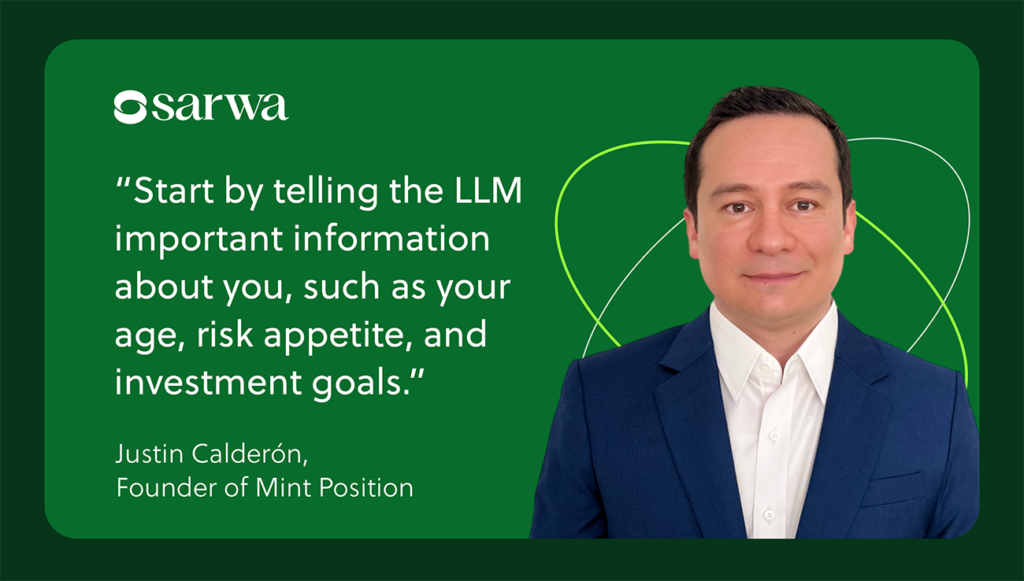
“Instruct an LLM to speak to you like a senior stock analyst,” says Justin Calderón, founder of Mint Position, a leading fintech content marketing agency for SEO and GEO. “Then start by telling the LLM important information about you, such as your age, risk appetite, and investment goals. You can even upload an Excel of your stock portfolio, as well as stocks on your watchlist, and ask it to help you review your portfolio.”
A well-briefed AI will start to act much more like this level of expert, instead of a junior assistant.
5 things to tell your AI before you start
Tell your AI tool the following information before you ask it for any stock analysis or market forecast.
- Your age and occupation. These determine your risk profile and time horizon more than you might think.
- Your risk tolerance. To get the right results, you should specify if you’re risk-averse
- , moderate, or aggressive.
- Your investment goals. Do you want to grow your wealth? Make passive income? Preserve your capital? Disclosing this now will help your investment strategy.
- Your base currency and location. This is particularly important for UAE-based investors as the AED-USD peg, regional geopolitical exposure, and local market hours all change the analysis. Without this context, your AI is effectively advising someone based in New York.
- Your time horizon. A portfolio can look very different for a 20-year investor compared to someone who needs liquidity in 18 months.
Beyond these data points, you should also tell AI the reasoning behind each selection,
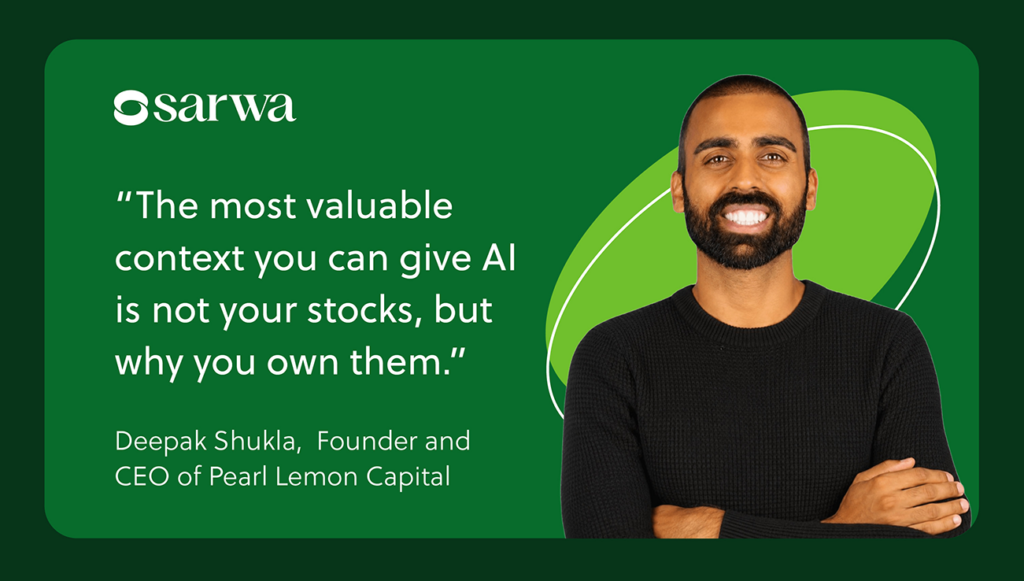
“The most valuable context you can give AI is not your stocks, but why you own them,” says Deepak Shukla, Founder and CEO of Pearl Lemon Capital. “Most beginners skip that and get surface-level answers that sound smart but aren’t actionable.”
Did you get involved because you spotted a short-term trading opportunity in market movements, or because you need a long-term hold based on fundamentals? Whatever the answer is, let the AI tool know.
This is a small step, but it prompts AI to push back on weak reasoning and help you improve your portfolio.
The 5 best AI prompts for stock research
Once your context is set, you’re ready to put the most practical part of how to use AI to invest in stocks into action – the prompts themselves.
Generative AI tools can analyse your full allocation, flag underperforming stocks, and show you trading opportunities you might have missed. This kind of fundamental stock market analysis would take a human hours, but AI will do it in just a few minutes.
Below are five frameworks you can input into your LLM that experienced investors in the UAE are using for real portfolio decisions right now.
1. The portfolio review prompt
“I am a [age]-year-old [occupation] based in the UAE with a [risk tolerance] risk profile and a [X]-year investment horizon. My base currency is AED. Here is my current portfolio [upload Excel]. Please review it against my investment goals of [goal] and identify any allocation gaps, concentration risks, or positions that no longer fit my thesis.”
2. The stock thesis validator
“I’m considering adding [stock] to my portfolio. Here is my thesis: [explain why]. Based on recent earnings calls, market sentiment, and current market conditions, what are the strongest arguments against this position?”
3. The UAE context prompt
“Factor in that I am based in the UAE. Consider AED-USD dynamics, my exposure to oil price movements, regional geopolitical risk, and the fact that I am trading across different market hours. How does this change your analysis?”
4. The risk check prompt
“I am about to make this trade: [details]. What are the three strongest reasons not to do this right now? What data points or market movements would change your view?”
5. The watchlist ranker
“Here are eight stocks on my watchlist [list them]. Based on my risk profile and goals above, rank them by fit and give me your top two with specific triggers for when I should consider deploying cash.”
Ranking is a particularly useful LLM capability that you can build into other areas of your routine, including regular portfolio reviews, which will help you improve your approach.
“You can ask AI to give you a portfolio grade for each review section – allowing you to measure your portfolio’s health over time,” says Justin Calderon.
At the end of each session, ask your AI to grade your portfolio across three core categories:
- Allocation health – is your capital distributed in line with your stated risk tolerance and goals, or has drift crept in?
- Thesis integrity – do you still own each position for the reason you bought it, or are you holding out of habit?
- Cash deployment readiness – do you have a clear, pre-defined trigger for when and how to deploy cash sitting on the sidelines?
Ask for a score out of ten for each. Save the output. Run it again next month. Over time, you build a data-driven picture of your portfolio’s health that no gut feeling can replicate.
Which tool works best for each prompt type
Different AI providers have different strengths for stock research, and experts are making full use of this. Hamzeh Abu Qamar, CEO & Co-Founder at VIBE and AI Tutor at xAI, has built a multi-model stack for his portfolio that treats each tool as a specialist rather than a generalist.
As a general guide:
- Claude works best for document-heavy analysis, uploading full portfolio spreadsheets, and structured long-form reviews. Hamzeh uses it as his core reasoning engine, as the main brain of his system.
- ChatGPT is particularly strong for broad research, idea generation, and summarizing news articles and social media sentiment around a stock.
- Gemini is useful for real-time market data cross-referencing, particularly when linked to Google’s data tools, including integrations with Microsoft-adjacent financial datasets. Hamzeh also uses Gemini Flash specifically for visual tasks such as reading charts and image-based outputs.
- Grok is worth adding for Twitter/X sentiment analysis and real-time social signals. This is particularly useful for gauging short-term market mood around a specific ticker.
- Perplexity rounds out the stack for deep web research. It can pull structured and cited information that other models may miss.
Together, these tools cover every layer of the research process, including fundamentals, sentiment, technicals, and portfolio analysis.
Most beginners won’t need all five, but knowing which tool to reach for and when is what separates a scattered AI workflow from a genuinely useful one.
NOTE: None of these AI-powered tools replaces a licensed financial advisor, and none have live brokerage access. They do, however, sharpen the research phase (often the most time-consuming and emotionally distorted part of investing) significantly.
AI can give you extremely valuable insights, but you must also form your own judgment.
The key is to use AI to challenge and refine your own views, not to do the thinking for you. Only then does it become the powerful investing tool it’s capable of being.
AI investing mistakes to avoid
Understanding how to invest in stocks using AI also means knowing what not to do.
AI advancements are a genuine breakthrough in helping beginners trade sensibly, but they also open up the possibility of making a new batch of mistakes.
Using AI to confirm what you already want to do, for example, is the most common trap in stock picking. Instead of simply asking the tool to analyse it and seek validation, ask it to take the opposite stance, such as “What’s the strongest case against this position?. You then get to stress-test your choice, or even pick holes in it.
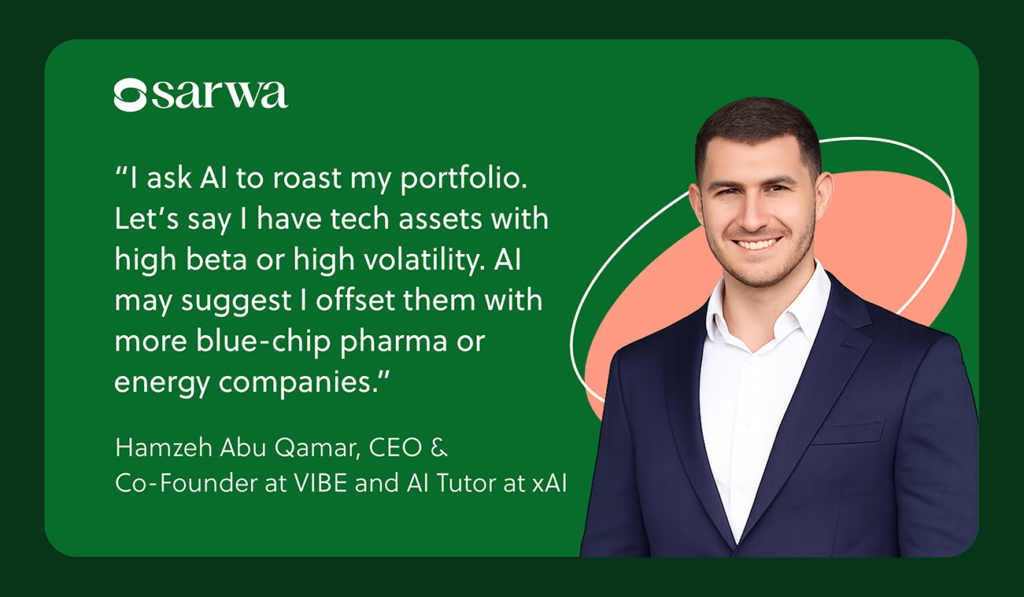
“I ask AI to roast my portfolio,” says Hamzeh Abu Qamar. “Let’s say I have tech assets with high beta or high volatility. AI may suggest I offset them with more blue-chip pharma or energy companies.”
Many investors also treat every AI output as a day-trading signal, but this is a (potentially expensive) misunderstanding of what AI algorithms can do. They don’t track stock prices or market movements, so they shouldn’t be used as a real-time market feed. Instead, they use natural language processing to digest and interpret large volumes of text-based information and turn it into a structured analysis.
Finally, trusting generic AI output is another pitfall that will lead you to mistakes. It may sound like expert personal finance guidance, but it isn’t yours.
The bottom line is that AI helps you think more clearly, not act for you. The investors who get the most from these tools are those who use them to sharpen their own judgment, and then execute on a platform built to complete the job.
From AI insight to actual trade: How to execute
The final piece of how to use AI for investing in stocks successfully is what happens after the analysis.
A valuable AI insight can quickly unravel if the path to a successful trade is unclear.
Here, a structured plan is essential because it reduces the possibility of second-guessing or emotional decision-making.
A four-step process like the one that follows can turn a strong AI-validated thesis into a clean, confident trade.
The four-step execution framework
Step 1: Cross-check your AI findings
Your first step should be to cross-check what the AI has surfaced.
Check news articles, earnings, and anything that can confirm the fundamentals still hold. Because AI models work from historical data with cutoff dates, their theses can quickly be put out of date by real-time market conditions – you’re responsible for closing this gap.
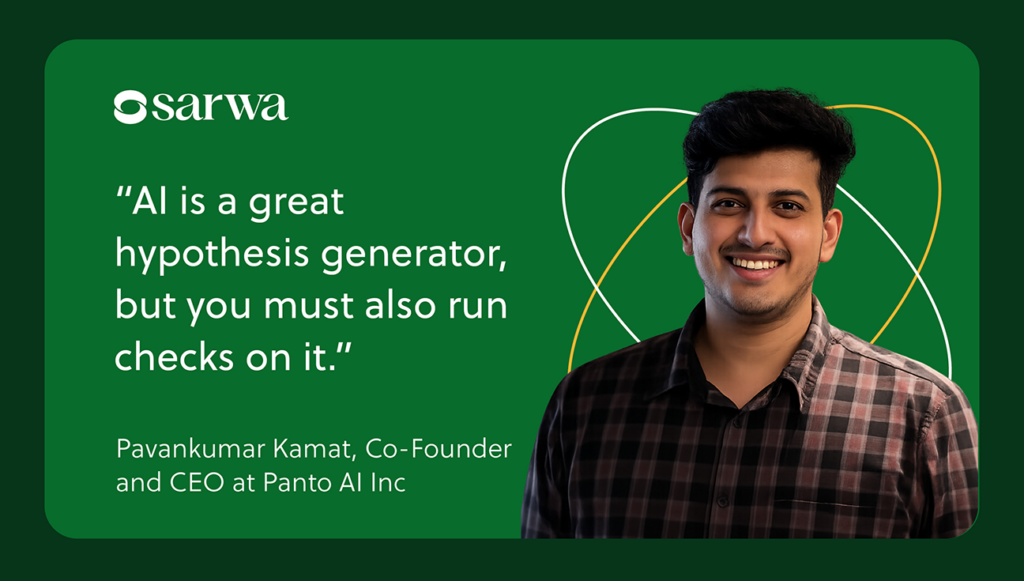
“AI is a great hypothesis generator, but you must also run checks on it,” says Pavankumar Kamat, Co-Founder and CEO at Panto AI Inc, an AI automation testing platform. “Confirm recent filings, verify liquidity and bid/ask spreads, check news flow and insider activity, and stress-test the thesis against downside scenarios.”
Only once that filter is passed, should you convert the insight into a concrete execution plan.
Step 2: Build your execution plan before you open the app
You must have your position clear in your mind before you go to trade. Ask yourself the following:
- How much capital am I allocating, and what percentage of my portfolio is this?
- What’s my entry point? Am I ready to stage my entry to manage timing risk?
- What’s my exit trigger – both upside target and downside limit?
Investors who skip this step simply open themselves up to impulsive decision-making at the worst possible time: when the trade is live, and pressure is at its peak.
Step 3: Set your cash deployment triggers
Holding cash for the right moment is fine, as long as you know when to strike.
AI can help you set specific triggers, including a certain price level, an earnings event, or a shift in market conditions. This will help you be proactive, rather than reacting to market events.
Step 4: Execute on a platform built for it
A strong plan needs fast execution to work, which is where an efficient trading platform like Sarwa fits into the workflow.
Low-friction and cost-transparent, Sarwa gives you direct access to US and global markets via a mobile-first interface designed for investors who want to move from decision to trade smoothly.
“A great broker app is the control layer,” says Pavankumar Kamat. “It should offer reliable order types, transparent fees, fractional sizing for accurate risk management, integrated portfolio views, and quick settlement to close the feedback loop from signal to position.”
The most common mistake investors make at this stage is waiting too long to make the right trade. In high-volatility windows, a 48-hour delay between insight and execution can cost more than the trade itself would have earned.
Having the platform ready, with an account funded, watchlist loaded, and position sizes pre-calculated, is a big part of a successful day trading strategy.
How to use AI to invest in stocks in the UAE without hidden fees or friction
Every step in this guide – the prompts, the portfolio grading, the execution framework – assumes one thing: that when the analysis is done, you have a platform capable of completing your trade properly.
For UAE-based investors, that platform is Sarwa.
The reason Sarwa fits the AI investing workflow so well is that AI trading analysis produces insights that require fast, low-friction execution on a regulated platform that understands the UAE market.
Sarwa is consistently rated the best trading app in the UAE because it ticks all those boxes and helps beginners build an AI-assisted practice, for both active and passive investment
Sarwa Trade, a self-directed trading platform for active investors, comes with:
- 5,000+ stocks and ETFs, with direct access to both US markets and UAE investment opportunities, from large-cap tech to sector ETFs, all from a mobile-first app built for stock trading on the move
- Fractional shares. Buy positions sized to your actual portfolio management plan, not rounded to whatever a full share costs. This is essential for beginners using AI to define precise allocation targets.
- Low, transparent fees of $1 or 0.25% of traded value, with no hidden charges, no inactivity fees, and no withdrawal fees, so the cost of executing your AI-informed trading strategies doesn’t eat into your returns.
- Mobile-first execution, designed so that moving from an AI-validated insight to a live trade takes minutes, not a phone call.
Sarwa Invest, meanwhile, takes the AI workflow full-circle with hands-off, automated portfolio management, based on your risk profile and goals. This means your risk profile and goals aren’t just context for an AI conversation: they’re the engine running your portfolio automatically in the background.
Sarwa is supervised by the Financial Services Regulatory Authority in Abu Dhabi Global Markets and also operates under the oversight of the Dubai Financial Services Authority — the regulatory backbone that matters when you’re making real investment decisions with real capital in the UAE.
The best AI investing workflow in the world is only as good as where it lands. Sarwa is where the analysis becomes the trade.
AI can be a great investing tool, but you also need the right platform to act on it. Sign up for Sarwa to find out how you can trade with more confidence in the UAE.